Chile
Facts & Figures
-
Official name: The Republic of Chile (La República de Chile)
President: Gabriel Boric (2022)
Land area: 287,187 sq mi (743,812 sq km); total area: 291,932 sq mi (756,102 sq km)
Population (2022 est.): 18,430,408 (growth rate: 0.66%); birth rate: 12.75/1000; infant mortality rate: 6.55/1000; life expectancy: 79.79
Capital and largest city (2022 est.): Santiago de Chile, 6.857 million
Other large cities: Valparaiso 1.000 million; Concepcion 902,000 (2022)
Monetary unit: Chilean Peso
National name: República de Chile
Language: Spanish 99.5% (official), English 10.2%, indigenous 1% (includes Mapudungun, Aymara, Quechua, Rapa Nui), other 2.3%, unspecified 0.2% note: the sum is greater than 100% because some respondents gave more than one answer on the census (2012 est.)
Ethnicity/race: white and non-indigenous 88.9%, Mapuche 9.1%, Aymara 0.7%, other indigenous groups 1% (includes Rapa Nui, Likan Antai, Quechua, Colla, Diaguita, Kawesqar, Yagan or Yamana), unspecified 0.3% (2012 est.)
National Holiday: Independence Day, September 18
Religions: Roman Catholic 60%, Evangelical 18%, atheist or agnostic 4%, none 17% (2018 est.)
Literacy rate: 96.4% (2017 est.)
Economic summary: GDP/PPP (2020 est.): $445.88 billion; per capita $23,300. Real growth rate: 1.03%. Inflation: 2.2%. Unemployment: 7.22%. Arable land: 1.7%. Agriculture: grapes, apples, pears, onions, wheat, corn, oats, peaches, garlic, asparagus, beans; beef, poultry, wool; fish; timber. Labor force: 7.249 million; agriculture 9.2%, industry 23.7%, services 67.1% (2013). Industries: copper, other minerals, foodstuffs, fish processing, iron and steel, wood and wood products, transport equipment, cement, textiles. Natural resources: copper, timber, iron ore, nitrates, precious metals, molybdenum, hydropower. Exports: $79.8 billion (2020 est.): copper, fruit, fish products, paper and pulp, chemicals, wine. Imports: $66.43 billion (2020 est.): petroleum and petroleum products, chemicals, electrical and telecommunications equipment, industrial machinery, vehicles, natural gas. Major trading partners: U.S., Japan, China, South Korea, Brazil, Argentina (2019).
Communications: Telephones: main lines in use: 2,567,938 (2020); mobile cellular: 25,068,249 (2020). Broadcast media: national and local terrestrial TV channels, coupled with extensive cable TV networks; the state-owned Television Nacional de Chile (TVN) network is self financed through commercial advertising revenues and is not under direct government control; large number of privately owned TV stations; about 250 radio stations (2020). Internet hosts: 3,763,826 (2020). Internet users: 16,822,264 (2020).
Transportation: Railways: total: 7,282 km (2014). Highways: total: 77,764 (2010). Waterways: 725 km. Ports and harbors: Coronel, Huasco, Lirquen, Puerto Ventanas, San Antonio, San Vicente, Valparaiso. Airports: 481 (2021 est.).

Index
- Chile Profile
- History
- News and Current Events
Geography
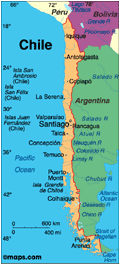
Situated in the southern hemisphere south of Peru and west of Bolivia and Argentina, The Republic of Chile fills a narrow 2,880-mi (4,506 kilometers) strip between the Andes Mountains and the Pacific Ocean. It’s the world’s southernmost country that is still on the mainland.
Chile shares borders with three neighboring South American countries. In order of shared border length, these are Argentina (4,158 km), Bolivia (585 km), and Peru (104 km). One-third of Chile is covered by the towering ranges of the Andes Mountains along the country’s eastern flank.
Although the country stretches more than 2,800 miles from north to south, it’s only 217 miles (350 kilometers) wide at its widest point. Its narrowest point measures 40 miles (64 kilometers), for an average of 109 miles (175 kilometers).
Chile also claims nearly half a million square miles of Antarctica as its territory, though that claim is suspended under the Antarctic Treaty. In addition, Chile controls Easter Island and Sala y Gomez Island, the easternmost islands of Polynesia.
Chile is divided into four zones: the Norte Grande, Norte Chico, Central Zone, and Southern Zone.
Norte Grande
This zone extends south from the Peruvian border to the Copiapó River.
The Norte Grande hosts the driest place on Earth, the Atacama Desert. This cold desert contains great mineral wealth in the form of copper and nitrates.
The area has almost no rain or vegetation, except on the slopes of some snowy peaks, where melting snow can provide water. Around the edges of the deserts, in some areas, underground aquifers provide water for forests of spiny Tamarugo trees.
Traveling southwest, barren rolling hills, and irregular lateral mountain ranges enclose elevated salt flats, including the Salar de Atacama.
From there, the desert plateau breaks down into steep bluffs near the coastline. This generates microclimates, as the bluffs trap ocean fog (Camanchaca) and clouds.
The Puna de Atacama, a bleak, high, arid plateau that extends from the Altiplano in Bolivia, lies in the eastern part of Norte Grande. A line of volcanoes runs from north to south, and a large part of its surface is covered in Lava beds. The area is also host to a number of shallow salt lakes.
Unlike in the desert, the Puna de Atacama receives quite a bit of rain during the summer months, and its lakes become home to three different species of flamingo, as well as numerous other birds.
The town of San Pedro de Atacama is a hotspot for archaeology. In addition to the R. P. Gustavo Le Paige Archaeological Museum, visitors can see impressive pre-Columbian ruins.
Norte Chico
South of the Norte Grande region is Norte Chico or the “near north.”
Norte Chico is a semiarid region that is prone to drought— even more so with the changes that come with climate change. The northern areas and the coast are barren, but the rainfall and snowmelt from the Andes provide year-round water farther south.
One of the northern coastal microclimates is the Valdevian temperate rainforest. The Bosque de Fray Jorge National Park is one place to see the unique vegetation that lives there.
Farther south, the Norte Chico district is quite mountainous, with green, fertile valleys, which provide land for orchards and cattle.
Dry, cloudless areas in Norte Chico provide outstanding conditions for astronomical observation, and the Cerro Tololo Inter-American Observatory and La Silla Observatory are located there.
Central Zone
Central Chile is the most populous area of the country and includes the Santiago, Valparaíso, and Concepción metropolitan areas.
The Central Zone is bordered by the Andes mountains to the east and coastal mountains to the west. The Central Valley, which lies between these ranges, is incredibly rich. This is where many of the grapes are grown that supply Chile’s renowned wine industry.
Other crops grown in the Central Valley include peaches, apples, and berries, many of which are exported to supply summer fruits year-round to the northern hemisphere.
The area enjoys a Mediterranean climate, with summer rains that increase as one travels south. Moderate winter temperatures combined with Andean snow create ideal conditions for Alpine skiing.
The southern part of this region also has excellent agricultural land, as well as beaches and old-growth forests, some of which have been reserved as national parks.
The Chiloé Archipelago lies off the coast of the mainland, across the Chacao Channel. The islands are covered in forests and wetlands with some mountains and are host to a unique culture that blends Huilliche, Spanish, and Chono influences.
The Araucania region is in Central Chile. This is the traditional heart of the indigenous Mapuche people. It’s one of the poorest regions of the country, and ground zero for the ongoing conflict between the Mapuche community, the Chilean government, and the forestry industry.
Southern Zone
Stretching down from the Biobío River near Concepcion, Southern Chile is home to some of the country’s most famous names, including Patagonia, Easter Island, and Cape Horn.
The south is one of the rainiest places in the world, with some parts receiving as much as 99 inches of rain per year. The northern pastures are the center of the country’s cattle and dairy production. Berry farming and lumber are also important industries in this area.
Patagonia is an area of the Andes mountains shared by Chile and Argentina. The eastern part has lakes, fjords, temperate rainforests, and glaciers. The western section consists of deserts, buttes, and steppes.
The sparsely populated Magallanes Region is the southernmost district of Chile. Two of the area’s signal features are the Strait of Magellan and Cape Horn. Oil extraction and sheep farming are two of this area’s main industries.
Chile’s territory extends past the mainland of South America to the Juan Fernandez Islands, about 400 miles (644 kilometers) west of Mainland Chile, and Easter Island, which lies 2,000 miles (3,219) miles west.
Government
Chile is a republic. The government has three branches: the executive, legislative, and judicial.
The executive branch is headed by the president, who serves for four years. The president appoints the presidential cabinet.
The legislative branch is the bicameral Congreso Nacional, which consists of the Senate and the Chamber of Deputies. There are 50 senators, who serve for eight years. The 155 deputies serve for four years.
The judicial branch consists of the Supreme Court, the Constitutional Court, the Elections Qualifying Court, and the lower courts. The Supreme court has a president and 20 ministers. The Constitutional Court has ten members and is independent of the other parts of the judiciary. The Elections Qualifying Court has five members.
The lower courts include the Courts of Appeal, oral criminal tribunals, military tribunals, local police courts, specialized tribunals, and family, labor, customs, taxes, and electoral affairs courts.
In addition, Chile has 16 administrative regions: Aysen, Antofagasta, Araucania, Arica y Parinacota, Atacama, Biobio, Coquimbo, Libertador General Bernardo O'Higgins, Los Lagos, Los Rios, Magallanes y de la Antartica Chilena (Magallanes and Chilean Antarctica), Maule, Nuble, Region Metropolitana (Santiago), Tarapaca, and Valparaiso.
Elections
The president is elected every four years by a direct majority. Senators and Deputies are elected by open list direct proportional representation. Senators are elected every eight years, and deputies are elected every four years.
This Latin American country currently has 28 political parties.
Until the 2017 election, Chilean elections had been based on a system known as binomialism. This system was designed to create a stable government from election to election.
Binomialism meant that unless the most popular party was more than twice as popular as the next most popular party, each district of the country would elect one representative from each of the two biggest political parties.
Critics claimed that this was an undemocratic feature of the government that made it harder for small parties to gain seats, and didn't reflect the opinions of the general public. For the 2017 general election, the binomial system was abandoned.
Constitutions
The first Chilean constitution was adopted in 1925. The most recent constitution was adopted on September 11, 1980.
A 2020 referendum approved a convention to draft a new convention. Members were elected to the convention in May of 2021.
The new constitution was put up for a vote on September 4, 2022, but was rejected by voters. In December 2022, the process began anew.
Human Rights
In 1973, a military coup toppled President Salvador Allende. General Augusto Pinochet took power. Pinochet ruled as a brutal authoritarian dictator. His rule was characterized by torture, disappearances, illegal arrest, and extrajudicial killings.
It’s estimated that between 1,200 to 3,200 people were executed, 80,000 were interned, and tens of thousands were tortured under Pinochet’s rule from 1973 to 1990.
International Affairs
Chile has been involved with several international situations that have drawn eyes from around the globe, including the following.
International Disputes
Chile currently has several ongoing disputes with other countries.
Bolivia: In 1884, Bolivia ceded the Atacama Corridor to Chile following the War of the Pacific. This was Bolivia’s only coastal territory. Bolivia currently desires sovereign access to the coast. Although Chile and Peru provide unrestricted access to ports, it’s still a point of conflict.
Peru: Chile and Peru are in conflict over Peru’s unilateral decision to change its latitudinal maritime boundary with Chile. This conflict has made its way to the International Court of Justice.
Argentina and Britain: Latin America isn’t the only site of Chile’s conflicts. The Chilean Antarctic Territory partially overlaps territories claimed by Argentina and Britain.
Argentina: The joint boundary commission, established by Chile and Argentina in 2001, has yet to map and demarcate the delimited boundary between the two countries in the Southern Patagonian Ice Field (Campo de Hielo Sur).
Illicit Drugs
Chile participates in the drug trade as a transshipment country for cocaine destined for Europe. There is also money laundering activity, especially through the Iquique Free Trade Zone. Imported drug precursors pass through Chile en route to Bolivia.
Inside Chile, domestic cocaine consumption is rising, and Chile is becoming a significant consumer of cocaine.
Refugees and Displaced Persons
A 2020 estimate puts the number of economic and political refugees in Chile at 448,138.
Culture
Chile is a culturally diverse country, with significant influence from indigenous peoples, especially the Mapuche and the Aymara. The Patagonians and the Rapanui of Easter Island are also notable.
Spanish influences remain strong, but beginning in the 19th century, immigrants from other parts of Europe, particularly France and Germany, began to leave their mark as well.
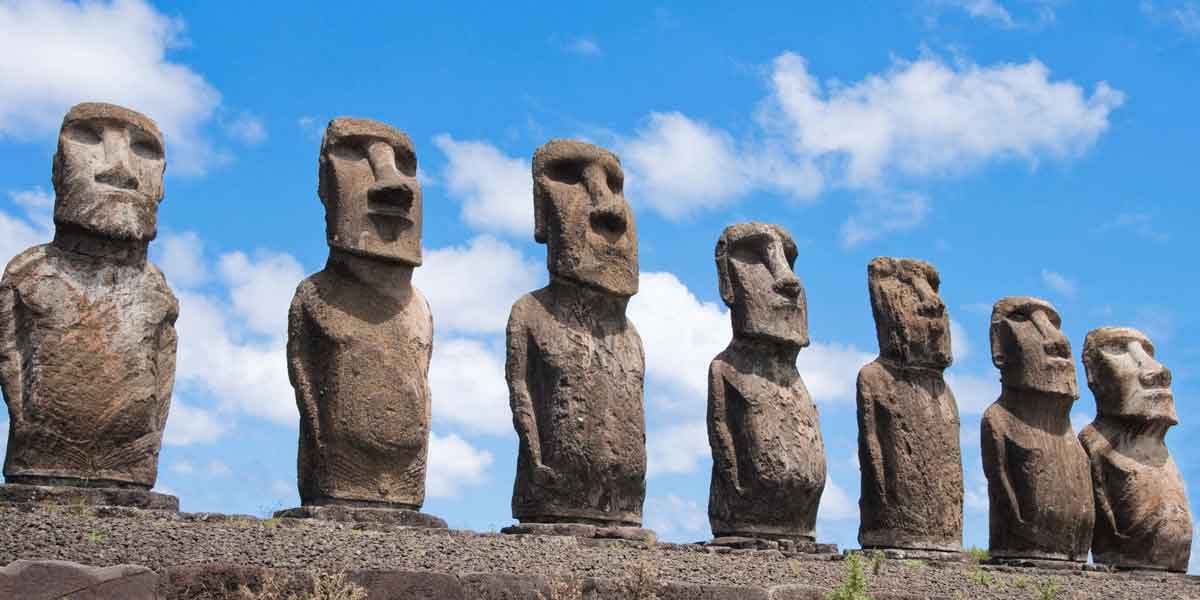
The most famous ethno-tourist destination is Easter Island, which hosts many megalithic monuments left by the island's historical Rapa Nui population.
Despite some disputes and shortcomings (such as the current conflict over Mapuche autonomy), Chile has made some notable efforts to preserve local cultures. For example, while indigenous languages are dying out in many places, the Mapuche still speak their cultural language (Mapudungun) at a sustainable rate.
Chile has numerous UNESCO World Heritage Sites, including Rapa Nui National Park, the Churches of Chiloé, the historical district in Valparaiso, the Humberstone and Santa Laura Saltpeter Works, and the mining town of Sewell.
Local Cuisine
Chile’s vastly diverse terrains and climates produce a similar diversity of foods.
Chilean cuisine contains influences of Spanish, Mapuche, and German cultures. Because of the country’s long coastline, seafood is an important part of the Chilean diet. Chile is home to unique fish, shellfish, mollusks, and algae.
Fruits, vegetables, and beef also figure prominently. Quechua influences include llama meat, shellfish, and rice bread.
Chile is also one of the world’s leading producers of wine.
What Language is Spoken in the Country?
Chile’s official language is Spanish. Around 10 percent of Chileans also speak English. Several indigenous languages are also spoken, including Mapudungun, Aymara, Quechua, and Rapa Nui. Many Chileans speak more than one language.
National Holiday and Why It’s Important
Chilean Independence Day is celebrated on September 18, commemorating Chile’s declaration of an autonomous republic, independent from Spain, in 1810. (Spain would not recognize the independence until 1818).
Arts and Entertainment
Chile is renowned for its diverse and vibrant arts, from music to literature.
Music
Chilean Music is as diverse as its geography, and styles follow geographical lines. The north, central, and southern parts of the country all have different styles. Two important styles are rooted in Mapuche and Easter Island culture.
Chile was also one of the most prominent nations during the Nueva Canción movement. Chilean bands reached particular importance during the presidency of Salvador Allende, as part of his broader cultural policies of bringing art and culture to all levels of Chilean society.
The mid- to late 20th century saw a rebirth in Chilean folk music. Chilean rock bands like Los Jaivas and La Ley have reached international success. And in February, Vina del Mar hosts a music festival.
Literature
Some of the world’s most widely acclaimed poets come from Chile, including Nobel Prize winners Gabriela Mistral and Pablo Neruda.
The poetry scene in Chile is also a major venue for Mapuche artists, who often work in both Mapudungun and Spanish.
Chilean novelists have achieved global success, including Roberto Bolaño and José Donoso. Isabel Allende is perhaps the most popular Spanish-language writer in the world. She was honored with a Presidential Medal of Freedom by US president Barack Obama.
Sports
Rodeo is Chile’s national sport.
As in many countries in Latin America and around the world, football is very popular, both as a spectator sport and in terms of participation. Chile has participated in nine FIFA World Cup competitions, and hosted the World Cup in 1982.
Tennis is also quite popular. In the 2004 Olympic Games, Chile captured the gold and bronze in Men’s singles, and the gold in Men’s doubles.
Other popular sports include Alpine skiing, polo, snowboarding, and surfing.
Religion
According to a 2018 estimate, 78 percent of Chileans identify as Christian, with 60 percent identifying as Catholic, and 18 percent identifying as Evangelical. The remaining 22 percent of the population identify as atheist, agnostic, or “none.”
Economy
Chile has the highest United Nations Human Development Index ranking ranking in Latin America, and the 42nd highest in the world. The Human Development Index measures the standard of living, life expectancy, education, and inequality.
Chile has 26 trade agreements with 60 countries, including the United States.
Chile has a market economy with a high level of foreign trade. It has a reputation for strong financial institutions and sound economic policy. Exports make up one-third of Chile’s GDP, with the primary export being copper.
Other important industries include lithium, oil, other minerals, iron and steel, wood, cement, and textiles. Foodstuffs are also important, and include wine, grapes, apples, wheat, sugar beets, milk, potatoes, tomatoes, maize, poultry, and pork.
History
During Chile's pre-history, early peoples settled in different parts of what is now Chile at different times.
Chile’s coastal areas and fertile valleys were settled by indigenous people around 10,000 years ago, while stone tool evidence indicates human activity in the Monte Verde Valley in the central-southern part of the country as much as 18,500 years ago.
Estimates on the arrival of the first people to Easter Island range from 300 CE to 1200 CE.
The Mapuche
The Mapuche are a multi-ethnic group of people united by religion, social customs, and the Mapudungun language. They arrived in Chile around 600 to 500 BCE.
mDNA analysis suggests that the Mapuche are descendants of people who migrated to Chile from the Amazon Basin. Another theory is that the Mapuche are descended from Aymara peoples who migrated south due to conflict.
The collapse of the Tiwanaku Empire in 1000 BC led to an influx of Tiwanaku people into the area. Archaeological evidence also suggests an exchange between the Mapuche and Polynesian peoples of the Western Pacific.
The Inca
The Inca Empire arose in the 1300s CE in the Andean Highlands, and would eventually expand to include Peru, Ecuador, western and south-central Bolivia, northwestern Argentina, the southernmost tip of Colombia, and the northern part of Chile.
The empire was highly organized, with accomplished metalworking and a vast system of roads. It has been called one of the greatest imperial states in human history.
The Incas would rule in northern Chile from the 1470s to the 1530s.
The Inca and the Mapuche
For a long time, the Mapuche ruled Chile in the south, while the Inca empire ruled in the north.
The Battle of the Maule, which historians place between 1471 and 1593 CE, was a spectacularly deadly battle, with some 35,000 deaths. The battle was a draw, but defined the line between the two territories.
From the exchange, the Mapuche gained knowledge of state organization, as well as gold and silver working. The Mapudungun language would also take on loan words from Imperial Quechua, the language of the Inca.
Spanish Colonization
The Spanish colonization of Chile took place from 1541 to 1604. The invasion was met with significant, continuous, and successful resistance from the Mapuche and other indigenous groups.
The first Spaniards to enter the territory were part of the Magellan expedition (1519). Twenty years later, Francisco Pizarro appointed Pedro de Valdivia as lieutenant governor and dispatched him to conquer Chile.
De Valdivia founded the city of Santiago in the central part of Chile, in 1539. It wasn’t an easy task; it took nine years. The city was subsequently destroyed by the Mapuche in 1541. De Valdivia would cross the Itata River in search of more land, only to be repelled again by the Mapuche.
The Juan Bautista Pastene expedition in 1544 set out to explore southern Chile. Their arrival at the Bio-Bio River would set off the Arauco War with the Mapuche people. This war would last for more than three hundred years, punctuated by fierce and successful uprisings by the Mapuche.
By 1598, indigenous people established a frontier between Mapuche territory and Spanish Chile. The Mapuche would remain largely independent until after Chile won independence from Spain in 1818.
Independence
In 1808, French ruler Napoleon Bonaparte deposed the Spanish king Ferdinand VII and installed his brother Joseph on the Spanish throne. In Chile, supporters of Ferdinand formed a junta and began to push for independence from Spain.
On September 18, 1810, Chile declared itself an autonomous republic. This resulted in the Reconquista— the Spanish attempt to regain control. Ultimately, Spain was unsuccessful and recognized Chile as independent on February 12, 1818.
Argentinian Bernardo O’Higgins and José de San Martin would rule Chile as dictators until 1823, though O’Higgins would lay the foundations for a two-party system and centralized government.
19th Century
Chile’s nineteenth century was a time of great expansion, conflict, and change.
With the economy booming following the discovery of silver, Chile set out to expand its territories. The Tantauco Treaty added the Chiloé Archipelago in 1826. Between 1836 and 1839, Chile would battle with Peru for maritime supremacy.
The Magallanes region joined the country in 1843, and the country intensified its penetration into Araucania.
From 1879 to 1883, Peru and Bolivia fought the War of the Pacific, which allowed Chile to expand its northern territories by nearly thirty percent, acquiring valuable nitrate deposits. By 1870, Chile was amongst the highest-income countries in South America.
A boundary treaty in 1881 between Argentina and Chile established Chile’s sovereignty over the Strait of Magellan.
The 1891 Chilean Civil War redistributed power between the President and Congress, allowing Chile to establish a parliamentary-style government.
20th Century
Over time, economic and governmental structures turned to favor banking interests and the oligarchy. The developing middle class became strong enough to advocate for its interests, and in 1920, the people elected reformer Arturo Alessandri.
A military junta drove Alessandri into exile in 1924, but he returned in 1925 to draft the country’s first constitution. His subsequent terms included many social and economic reforms, including universal male suffrage.
At the same time, his rule was marked by political violence and two massacres— one of striking workers, and another of coup plotters.
Constitutional rule was restored in 1932. For the next twenty years, Chile would be ruled by democratically elected coalition governments.
The 1964 election of president Eduardo Frei Montalva kicked off a period of social and economic reform, including education, housing, and agrarian reform.
Salvador Allende
In 1970, Salvador Allende became the first president freely elected on a Marxist platform. Allende formed alliances with Cuba and the People’s Republic of China and introduced socialist economic and social reforms.
Nationalization of US-owned companies brought him into conflict with the US. In September of 1973, a CIA-sponsored coup overthrew and killed Allende.
Augusto Pinochet
The leader of the 1973 coup was Army Chief of Staff Augusto Pinochet. Pinochet assumed the office of President.
Pinochet’s anti-Marxist rule would be marked by brutal repression of dissent and human rights, which would include suspending Parliament, disappearances, torture, execution, and expulsion of thousands of Chilean citizens. During his rule, an estimated 28,000 people were tortured, and 3,200 people disappeared.
Pinochet stepped down in 1990, in favor of Patricio Aylwin, and in 1993, center-left candidate Eduardo Frei Ruiz-Tagle was elected President.
Pinochet would retain his post as Army Commander in Chief. In October 1998, he was arrested in Britain with regard to an extradition request by Spain regarding the disappearance of Spanish citizens ruing his rule.
Britain eventually denied the request, and Pinochet returned to Chile in 2000. He died in December 2006 before facing trial for his abuses during his 17-year rule.
News and Current Events
Get caught up with the most important historic and current events in Chile.
Socialists Return to Power
Ricardo Lagos became president in March 2000, the first Socialist to run the country since Allende. Chile's economic growth slowed to 3% for 2001, partly the result of a drop in international copper prices and the economic turmoil in neighboring Argentina. In 2003, there were several minor financial scandals involving insider information and bribery. In response, Lagos introduced new reforms promising greater transparency. In 2004, Chile passed a law permitting divorce for the first time.
In 2006 presidential elections, Socialist Michelle Bachelet won 53% of the vote. The former pediatrician is a survivor of the Pinochet dictatorship, which was responsible for her father's death and subjected her to prison, torture, and exile. Bachelet took office on March 11, becoming Chile's first female chief of state. She promised to continue Chile's successful economic policies while increasing social spending. The president's first major challenge came when 700,000 of the nation's students organized a national boycott in May demanding educational reform. The students called off the strike in June after the government agreed to address their concerns.
In January 2008, president Bachelet swore in six new ministers to her 22-member cabinet. The major change was the appointment of Christian Democrat leader Edmundo Perez Yoma for Interior Minister, the top political post of the cabinet. Bachelet also replaced ministers of economy, public works, mining, agriculture, and planning. The cabinet changes are not expected to affect government policy.
Earthquake Devastates Beginning of Right-Wing Rule
In January 2010, for the first time in 50 years—since the rule of Pinochet—Chile elected a right-wing president. Billionaire businessman Sebastián Piñera narrowly defeated Eduardo Frei of the Concertacion, the center-left alliance that has been in power for 20 years, in the second round of voting. Piñera, who was elected to the Senate in 1990, owns a television station, a soccer club, and a large stake in the country's main airline, Lan Chile. He lost to outgoing Bachelet in the 2006 election, his first run for the presidency. Piñera said he would use his business acumen to create jobs give private industry a more prominent role in the economy. He has distanced himself from the Pinochet regime, and his cabinet is made up of a group of technocrats with no ties to Pinochet.
Chile was hit by an 8.8 magnitude earthquake in February 2010. Fatalities were relatively low, with some 500 people killed in the devastation. However, as many as 1.5 million people were displaced. The country, long known to be at high risk for earthquakes, has enforced strict building codes in urban areas, which helped to limit the amount of damage in these areas. But buildings and homes in poorer areas—many built with adobe—did not fare as well. Chile's electricity grids, communication, and transportation systems were badly damaged, severely hampering rescue and aid efforts. The epicenter of the quake was 70 miles northeast of Concepcion in central Chile. Massive waves caused additional damage along the coast.
In March 2010, Sebastián Piñera was sworn in as President of Chile, immediately following three major aftershocks from the recent massive earthquake. Piñera is the first right-wing president since Pinochet. He made an effort to distance himself from the former dictator, and he assembled a cabinet of technocrats with no ties to Pinochet. He faced the widespread devastation of his country following the February earthquake, visiting the quake zone directly after his inauguration. One of his first acts as the new president was to form an emergency response team to deal with the country's reconstruction in the aftermath of the disaster.
Fate of Trapped Miners Rivets the Nation
On Aug. 5, 2010, a tunnel collapsed at the San José mine, trapping 33 miners 2,000 feet below ground. Remarkably all of the miners survived. Rescuers drilled a small borehole to provide the miners with food, lights, and liquids and to allow them to send notes to and from family members as they wait to be rescued. The miners have become national heroes throughout Chile. They were rescued in mid-October, weeks earlier than planned, lifted to safety one by one in a rescue capsule. Each of the miners emerged jubilant and in overall good health considering the ordeal.
Plan for Hydroelectric Dams Causes Outrage
Immediately following the successful rescue of 33 miners in 2010, Chilean President Sebastián Piñera had an approval rating of 63 percent. By June 2011; however, Piñera had a disapproval rating of 56%, the highest of any Chilean president since democracy returned to the country in 1990. The main reason for the approval rating nosedive was Piñera's support for the Hidroaysén electricity project, a plan to build five dams on two rivers and flood over 14,000 acres of nature reserves in the Patagonia region.
A government environmental commission approved the $3.2 billion Hidroaysén project in May 2011, prompting a country-wide protest movement. The protests caused injuries to 28 police officers and over one hundred thousand dollars in property damage. One protest in early June involved 30,000 demonstrators marching to the presidential palace, with some protestors throwing stones and pieces of wood at police vehicles. The police fired back with water cannons. Since the commission's decision, the focus has turned to the yet-to-be-approved transmission line for the project. Patagonia, considered by Chileans to be a national treasure with its breathtaking glaciers and lakes, attracts thousands of tourists each year.
Chilean Youth Call for Reform
Throughout 2011, partly inspired by the Arab Spring, activists continued to protest and started a movement which came to be known as the Chilean Winter. On August 4, 2011, some protestors set up barricades around Santiago, the nation's capital, while others banged on pots and pans. Police used tear gas and water cannons to disperse hundreds of high school and college students. About 900 demonstrators were arrested. Also in August, nearly three dozen university and high school students went on a hunger strike to show their disapproval of President Piñera's government. These education protests have taken over several schools, forcing some to stop classes. Students organized rallies which were attended by 100,000 people. The protestors were demanding a more accessible and affordable university system as well as higher quality and equal funding for elementary and middle schools.
In October 2011, student representatives attempted to negotiate with government representatives led by Felipe Bulnes, the education minister. However, the students withdrew from the negotiations, reporting that Bulnes attacked a student representative, David Urrea. Bulnes reportedly accused Urrea of trying to break up the negotiations. A spokesperson for the government blamed extremists within the student movement for the breakdown of negotiations. Bulnes was replaced by Harald Beyer as education minister two months later.
Although the student protestors did not get all their demands met, they did influence a huge drop in President Piñera's approval rating. As of January 2012, Piñera's approval rating hovered around 26–30%.
Bachelet Regains the Presidency
Michelle Bachelet won a runoff presidential election against Evelyn Matthei on Dec. 15, 2013. Bachelet received 62.2% of the vote, Matthei 37.8%. Bachelet was the first person to be elected for a second term since Arturo Alessandri whose third term ended in 1938.
Bachelet first served as president from 2006 until 2010. She has also served as health minister and defense minister. Bachelet took office on March 11, 2014.
The Constitutional Process Begins Anew
In September 2022, voters rejected a proposed new constitution for Chile. In December 2022, the Chilean Senate approved a bill to start the constituent process anew.
A commission of five senators will install 50 representatives elected by Chilean voters, plus 24 experts appointed by the Chamber of Deputies, on a council tasked with discussing a new constitution.
Source: MSN News
Chile to Open an Embassy in Palestinian Territory
Chilean president Gabriel Boric announced that Chile plans to open an embassy in the Palestinian territories. It would be one of only a few countries to have an embassy in the contested territories.
There is no timeline for opening the embassy. Also, Chilean foreign minister Antonia Urrejola said that Chile will continue to recognize both Palestine and Israel as legitimate states.
Source: Reuters
Chilean Lawmakers Reach an Agreement to Start Work on a New Constitution
On December 12, 2022, Chilean lawmakers announced their intention to draft a new constitution. The new constitution will be drafted by a group of 50 elected constitutional advisors and would replace a dictatorship-era charter.
Once drafted, voters will vote for or against it in November or December of 2023.
It would be submitted for a referendum in November or December of the next year (2024), with mandatory public participation.
The new proposal came after voters rejected a proposed charter that would have been one of the most progressive in the world.
Source: Reuters
Columbia, ELN Rebels, ask Chile to Assist with Peace Negotiations
The government of Colombia and the National Liberation Army (ELN), a leftist guerilla group, have agreed to sit down to peace talks, with the hope of ending nearly 60 years of conflict. They have agreed to invite Brazil, Chile, Mexico, Cuba, Norway, and Venezuela to participate.
Colombia will also invite Germany, Sweden, Switzerland, and Spain to join and will encourage the United States to appoint a special envoy to the negotiating table. This is to ensure that both sides abide by the agreement.
Source: Reuters
Schools in Chile Voted Among World’s Best
Five schools from Chile, Scotland, Uganda, the Philippines, and the United States will share a quarter-million-dollar prize given by T4 Education.
The prize was given to schools for projects supporting schools and communities. Chile’s winning entry was by Escuela Emilia Lascar in Penaflor, for its program “Emilia TV,” which addressed various issues in the community, including gender identity and mental health.
The T4 organization was founded during the pandemic, with the goal of bringing teachers together from around the world via digital technology.
In a statement, T4 Education founder Vikas Pota said, “Far too many children will continue to be left behind in the wake of COVID unless governments take urgent action to tackle the education crisis... As a first step, they must turn to the knowledge and experience contained within our schools because those on the frontlines of education know better than anyone else the change we need to see."
The prize is called “The World’s Best School Prize.”
Source: US News & World Report
Learn More About Chile
South America is a place of breathtaking natural beauty and incredible cultural diversity. Would you like to learn more? Check out our South America learning hub. And, just for fun, take our South American Flags Quiz!
See also Encyclopedia: Chile.
U.S. State Dept. Country Notes: Chile
National Institute of Statistics (INE) (In Spanish only) www.ine.cl/ .