Mozambique
Facts & Figures
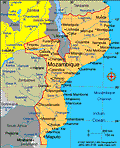
-
President: Filipe Nyusi (2015)
Prime Minister: Carlos Agostinho do Rosário (2015)
Land area: 302,737 sq mi (784,089 sq km); total area: 309,494 sq mi (801,590 sq km)
Population (2014 est.): 24,692,144 (growth rate: 2.45%); birth rate: 38.83/1000; infant mortality rate: 72.42/1000; life expectancy: 52.6. note: estimates for this country explicitly take into account the effects of excess mortality due to AIDS; this can result in lower life expectancy, higher infant mortality, higher death rates, lower population growth rates, and changes in the distribution of population by age and sex than would otherwise be expected (July 2014 est.)
Capital and largest city (2011 est.): Maputo, 1.15 million
Monetary unit: Metical
National name: República de Moçambique
Languages: Emakhuwa 25.3%, Portuguese (official) 10.7%, Xichangana 10.3%, Cisena 7.5%, Elomwe 7%, Echuwabo 5.1%, other Mozambican languages 30.1%, other 4% (1997 census)
Ethnicity/race: African 99.66% (Makhuwa, Tsonga, Lomwe, Sena, and others), Europeans 0.06%, Euro-Africans 0.2%, Indians 0.08%
Religions: Catholic 28.4%, Protestant 27.7% (Zionist Christian 15.5%, Evangelical Pentecostal 10.9%, Anglican 1.3%), Muslim 17.9%, other 7.2%, none 18.7% (1997 census)
National Holiday: Independence Day, June 25
Literacy rate: 56.1% (2010 est.)
Economic summary: GDP/PPP (2013 est.): $28.15 billion; per capita $1,200. Real growth rate: 7%. Inflation: 4.4%. Unemployment: 17% (1997 est.). Arable land: 6.51%. Agriculture: cotton, cashew nuts, sugarcane, tea, cassava (tapioca), corn, coconuts, sisal, citrus and tropical fruits, potatoes, sunflowers; beef, poultry. Labor force: 10.55 million (2013 est.); agriculture 81%, industry 6%, services 13% (1997 est.). Industries: aluminum, petroleum products, chemicals (fertilizer, soap, paints), textiles, cement, glass, asbestos, tobacco, food, beverages. Natural resources: coal, titanium, natural gas, hydropower, tantalum, graphite. Exports: $3.92 billion (2013 est.): aluminum, prawns, cashews, cotton, sugar, citrus, timber; bulk electricity. Imports: $7.068 billion (2013 est.): machinery and equipment, vehicles, fuel, chemicals, metal products, foodstuffs, textiles. Major trading partners: Belgium, South Africa, Italy, Spain, China, India, U.S., Australia, Portugal (2012).
Communications: Telephones: main lines in use: 88,100 (2012); mobile cellular: 8.108 million (2012). Broadcast media: 1 state-run TV station supplemented by private TV station; Portuguese state TV's African service, RTP Africa, and Brazilian-owned TV Miramar are available; state-run radio provides nearly 100% territorial coverage and broadcasts in multiple languages; a number of privately-owned and community-operated stations; transmissions of multiple international broadcasters are available (2007). Internet hosts: 89,737 (2012). Internet users: 613,600 (2009).
Transportation: Railways: total: 4,787 km (2008). Highways: total: 30,331 km; paved: 6,303 km; unpaved: 24,028 km (2008 est.). Waterways: 460 km (Zambezi River navigable to Tete and along Cahora Bassa Lake) (2010). Ports and terminals: Beira, Maputo, Nacala. Airports: 98 (2013).
International disputes: South Africa has placed military units to assist police operations along the border of Lesotho, Zimbabwe, and Mozambique to control smuggling, poaching, and illegal migration.