DK People & Places: Central Europe
- HOW DOES SKIING IN THE ALPS DAMAGE THE ENVIRONMENT?
- WHY IS LUXEMBOURG VITAL TO THE EUROPEAN UNION?
- WHICH COUNTRIES ARE KNOWN AS THE LOW COUNTRIES?
- WHICH COUNTRY IS EUROPE’S LARGEST FLOWER PRODUCER?
- HOW HAS REUNIFICATION AFFECTED GERMANY?
- WHICH COUNTRIES ARE HEAVILY INDUSTRIALIZED?
- WHY IS THE RHINE RIVER SO IMPORTANT TO EUROPE?
- FACTFILE: CENTRAL EUROPE
- FIND OUT MORE
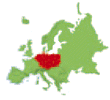
Nine very different countries form the heart of Europe. Germany, Luxembourg, and the Netherlands have thriving economies, but others, such as Poland, Slovakia, and the Czech Republic, face huge challenges as independent states after 40 years of Communist rule. Most of the region is flat and rolling, with some major rivers flowing to the North Sea.
Over 100 million tourists visit the Alps each year, and hotels, ski runs, lifts, and roads have all been built to cater for them. This has had a harmful effect on the Alpine environment. The destruction of forests, meadows, and grassy slopes threatens the survival of plants and animals and opens routes for dangerous avalanches. In recent years, creating national parks has helped conserve unspoiled areas.
Luxembourg, the smallest country in Europe, is home to the headquarters of the European Parliament and the European Court of Justice, two institutions of the European Union (EU). The EU encourages free trade and economic cooperation between its 15 members, 12 of which share a common currency, the euro.
Belgium, the Netherlands, and Luxembourg are known as the low countries because much of their land is flat and very low-lying. Almost one-third of the Netherlands has been reclaimed from marshland and the sea, and is enclosed by earth barriers called dikes. The drained soil is extremely fertile.
The Netherlands is a major producer of fresh flowers, which are exported daily to cities around the world. The country is famous for its cultivation of flower bulbs, such as crocuses, hyacinths, daffodils, and tulips, which have been grown here for over 400 years. Fields of Dutch tulips flower in the spring and are a major tourist attraction.
When East and West Germany became one country in 1990, a period of great change was introduced. After World War II, democratic West Germany became a wealthy, industrialized nation. In contrast, East Germany, run by the former Soviet Union, had little investment and inefficient industry. Since 1990, the former East Germany has slowly been modernized.
Poland and the Czech Republic are major producers of iron, steel, cars, ships, and industrial machinery, while Poland is a major exporter of coal and metals. Factories in these former Communist countries are old, poorly equipped, and pollute the environment, but their governments are slowly trying to make them cleaner and more productive.
The Rhine is one of Europe’s most important trade routes. Huge barges use the waterway to transport heavy freight such as timber, coal, and grain. The river starts in the Swiss Alps and flows northwest for 820 miles (1,320 km) through Germany and France. It empties into the North Sea at Rotterdam in the Netherlands, the world’s largest port.
Capital city: Brussels
Area: 11,780 sq miles (30,510 sq km)
Population: 10.3 million
Official languages: Dutch, French, and German
Major religion: Roman Catholic
Capital cities: Amsterdam; The Hague (administrative)
Area: 16,033 sq miles (41,526 sq km)
Population: 16.2 million
Official language: Dutch
Major religions: Roman Catholic and Protestant
Capital city: Luxembourg-Ville
Area: 998 sq miles (2,586 sq km)
Population: 448,000
Official languages: French, German, and Luxembourgish
Major religion: Roman Catholic
Capital city: Berlin
Area: 137,846 sq miles (357,021 sq km)
Population: 82 million
Official language: German
Major religions: Protestant and Roman Catholic
Capital city: Vaduz
Area: 62 sq miles (160 sq km)
Population: 32,842
Official language: German
Major religion: Roman Catholic
Capital city: Vienna
Area: 32,378 sq miles (83,858 sq km)
Population: 8.1 million
Official language: German
Major religion: Roman Catholic
Capital city: Prague
Area: 30,450 sq miles (78,866 sq km)
Population: 10.3 million
Official language: Czech
Major religions: Roman Catholic and atheist
Capital city: Warsaw
Area: 120,728 sq miles (312,685 sq km)
Population: 38.3 million
Official language: Polish
Major religion: Roman Catholic