DK Space: Venus
Seen from Earth shining brightly in the west at sunset, Venus is called the evening star. It is a rocky planet, and the second-closest planet to the Sun.
Table 6. VENUS DATA
| Diameter (width) at equator | 7,521 miles (12,104 km) |
| Average distance from Sun | 67.2 million miles (108.2 million km) |
| Time to orbit Sun | 224.7 days |
| Time to spin around own axis | 243 days |
| Mass | 0.82 x Earth’s mass |
| Gravity | 0.9 x Earth’s gravity |
| Average surface temperature | 867°F (464°C) |
| Number of moons | 0 |
Thick clouds in Venus’s atmosphere stop us from seeing the surface. Radar probes, such as Magellan, can peer through the clouds, revealing a planet dotted with volcanoes and covered with rolling lava plains.
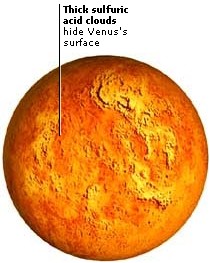
Temperatures on Venus soar to over 860°F (460°C), making it hotter than any other planet. Its carbon dioxide atmosphere, which is 100 times heavier than Earth’s, traps heat like a greenhouse.