DK Science: Flight
When something flies, it overcomes the force of gravity and moves through the air. Birds and aeroplanes fly using curved aerofoil wings that produce an upward force called lift. When birds flap their wings, they generate lift and move their bodies forwards at the same time. Aeroplanes generate lift with their aerofoil wings, but need engines to move them forwards.
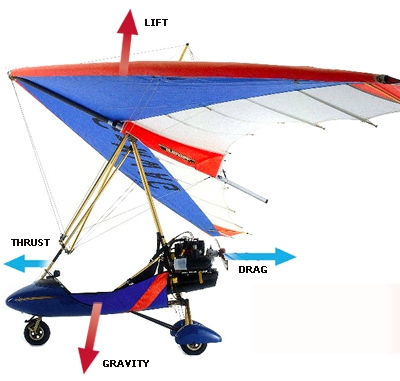
Four forces act on an aeroplane as it flies. The engine produces a force called thrust that pushes the plane forwards, while air resistance (drag) pulls in the opposite direction. As the plane moves forwards, the aerofoil wing creates lift. To stay in the air, the plane must move fast enough so that the lift is at least equal to its weight, caused by the force of gravity.
An aerofoil wing generates lift because of its curved shape. As the wing moves forwards, air has to travel faster over the curved top of the wing to keep up with the air moving underneath it. This lowers the air pressure above the wing and creates an upward force that overcomes the aeroplane’s weight. An aerofoil also creates drag that pulls the aeroplane backwards.
Pilots control and steer an aeroplane using the ailerons, rudder, and elevators. These are swivelling flaps built into the wings and the tail of the aeroplane.
The pilot can bank (roll) the aeroplane by using the ailerons. For example, he turns to the right by tilting the right aileron up and the left aileron down. This increases lift on the left wing, reduces lift on the right wing, and makes the plane bank and turn to the right.
The rudder is a vertical flap on the rear edge of the tailfin. The pilot can swivel it from side to side to help turn the aeroplane to the left or to the right without banking.