DK Science: Relativity
Einstein realized that the speed of light is always the same. He then calculated that an object travelling near this speed acts strangely: it shrinks in length, increases in mass, and time slows down. He also calculated that mass alters space. So small objects do not travel in straight lines near a large object – instead they follow the distortions in space made by it. Centuries after gravity was identified as a force, Einstein’s theory of relativity explained why it works the way it does.
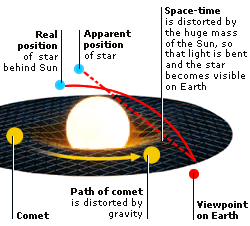
In traditional physics, gravity attracts one mass to another. This explains why a comet follows a curved path around the Sun. Einstein’s general theory of relativity explains gravity differently. Masses warp space and time a bit like heavy balls resting on a sheet of rubber. The bigger the mass, the more distortion, and the greater the pull of gravity. In 1921 Einstein was proved correct when the light from a star was shown to be bent by the warping effect of the Sun’s mass.
The effects of relativity are only detectable when things travel at very high speeds. To detect them, scientists need accurate clocks that use atoms to tell the time. Atoms of the element caesium vibrate at a precise rate. Atomic clocks measure time by counting these vibrations. Clocks such as the one above use a radio link to a central atomic clock to relay the precise time.
When Albert Einstein was expelled from school, no one imagined he would become one of the most brilliant physicists of the 20th century. His theory of relativity was so strange that people refused to believe it at first. It was widely accepted only after he won the Nobel Prize for Physics in 1921.