Geography
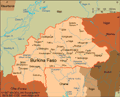
Slightly larger than Colorado, Burkina Faso, formerly known as Upper Volta, is a landlocked country in West Africa. Its neighbors are Côte d'Ivoire, Mali, Niger, Benin, Togo, and Ghana. The country consists of extensive plains, low hills, high savannas, and a desert area in the north.
Government
Parliamentary.
History
Burkina Faso was originally inhabited by the Bobo, Lobi, and Gurunsi peoples, with the Mossi and Gurma peoples immigrating to the region in the 14th century. The lands of the Mossi empire became a French protectorate in 1897, and by 1903 France had subjugated the other ethnic groups. Called Upper Volta by the French, it became a separate colony in 1919, was partitioned among Niger, the Sudan, and Côte d'Ivoire in 1932, and was reconstituted in 1947. An autonomous republic within the French Community, Upper Volta became independent on Aug. 5, 1960.
President Maurice Yameogo was deposed on Jan. 3, 1966, by a military coup led by Col. Sangoulé Lamizana, who dissolved the national assembly and suspended the constitution. Constitutional rule returned in 1978 with the election of an assembly and a presidential vote in June in which Gen. Lamizana won by a narrow margin over three other candidates.
On Nov. 25, 1980, Col. Sayé Zerbo led a bloodless coup that toppled Lamizana. In turn, Maj. Jean-Baptist Ouedraogo ousted Zerbo on Nov. 7, 1982. But the real revolutionary change occurred the following year when a 33-year-old flight commander, Thomas Sankara, took control. A Marxist-Leninist, he challenged the traditional Mossi chiefs, advocated women's liberation, and allied the country with North Korea, Libya, and Cuba. To sever ties to the colonial past, Sankara changed the name of the country in 1984 to Burkina Faso, which combines two of the nation's languages and means “the land of upright men.”
While Sankara's investments in schools, food production, and clinics brought some improvement in living standards, foreign investment declined, many businesses left the country, and unhappy labor unions began strikes. On Oct. 15, 1987, formerly loyal soldiers assassinated Sankara. His best friend and ally Blaise Compaoré became president. Compaoré immediately set about “rectifying” Sankara's revolution. In 1991, he agreed to economic reforms proposed by the World Bank. A new constitution paved the way for elections in 1991, which Compaoré won easily, although opposition parties boycotted. In 1998, he was reelected by a landslide. A coup against the president was foiled in 2003, and he was reelected a third time in 2005.
Prime Minister Yonli resigned in June 2007 and was replaced by Tertius Zongo, who has served as the ambassador to the United States and as the country's finance minister.
Violent protests by soldiers and police in the capital of Ouagadougou, sparked by low pay and unpaid housing allowances, were answered by President Blaise Compaore with a new government and a new head of the armed forces in the spring of 2011.
In Jan. 2013, Prime Minister Luc Adolphe Tiao's new government was announced; the main portfolios remain unchanged.
President Compaoré Is Deposed
In October 2014, President Compaoré, who served as president for 27 years, attempted to push a bill through parliament to allow him to serve another term. Violent protests broke out in the capital, and demonstrators set the parliament building on fire. Compaoré stepped down on October 31 and fled to nearby Ivory Coast. Gen. Honoré Nabéré Traoré claimed to be head of state and deployed troops into the streets. However, Lt. Col. Isaac Zida, the No. 2 figure in the presidential guard, resisted Traoré, and won the support of other commanders and became head of state. The African Union told the military leaders that if they did not cede power to civilians then sanctions would be imposed on the country.
In November, a panel of religious, military, political, and traditional leaders named Michel Kafando, a longtime diplomat, interim president. An agreement called for Kafando to oversee preparations for elections in late 2015. He will remain in office until elections are held. Kafando appointed Zida as prime minister—a move that prompted some to speculate that the military would control the transition to democracy. The U.S. has fostered ties with Burkina Faso in recent years in its fight against Islamic insurgents in West Africa and maintains a base there from which it launches reconnaissance flights into the region. In fact, Zida has been trained by U.S. troops.
On Nov. 29, 2015, opposition party leader Roch Marc Christian Kaboré won the presidential election in the first round of voting. Kaboré received 53.5% of the vote. Second place candidate Zephirin Diabré received 29.7%. Kaboré previously served as Burkina Faso's prime minister from 1994 through 1996, and as president of the National Assembly from 2002 until 2012. In Jan. 2014, he left the ruling Congress for Democracy and Progress party to found a new opposition party, the People's Movement for Progress. Kaboré took office in December. The following month, Paul Kaba Thieba was named prime minister. Thieba announced his government on Jan. 13, 2016.
See also Encyclopedia: Burkina Faso .
U.S. State Dept. Country Notes: Burkina Faso