Estonia
Facts & Figures
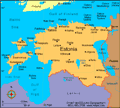
-
President: Toomas Hendrik Ilves (2006)
Prime Minister: Taavi Rõivas (2014)
Land area: 16,684 sq mi (43,211 sq km); total area: sq mi (sq km)
Population (2014 est.): 1,257,921; growth rate: –0.68%; birth rate: 10.29/1000; infant mortality rate: 6.7/1000; life expectancy: 74.07
Capital and largest city (2011 est.): Tallinn, 400,000
Other large city: Tartu, 100,100
Monetary unit: Kroon
National name: Eesti Vabariik
Languages: Estonian (official) 68.5%, Russian 29.6%, Ukrainian 0.6%, other 1.2%, unspecified 0.1% (2011 est.)
Ethnicity/race: Estonian 68.7%, Russian 24.8%, Ukrainian 1.7%, Belarusian 1%, Finn 0.6%, other 1.6%, unspecified 1.6% (2011 est.)
National Holiday: Independence Day, February 24
Religions: Lutheran 9.9%, Orthodox 16.2%, other Christian (including Methodist, Seventh-Day Adventist, Roman Catholic, Pentecostal) 2.2%, other 0.9%, none 54.1%, unspecified 16.7% (2011 est.)
Literacy: 99.8% (2011 est.)
Economic summary: GDP/PPP (2013 est.): $29.94 billion; per capita $22,400. Real growth rate: 1.5%. Inflation: 3.4%. Unemployment: 10.9.%. Arable land: 13.97%. Agriculture: potatoes, vegetables; livestock and dairy products; fish. Labor force: 692,900; industry 20.2%, agriculture 4.2%, services 75.6% (2010 est.). Industries: engineering, electronics, wood and wood products, textile; information technology, telecommunications. Natural resources: oil shale, peat, phosphorite, clay, limestone, sand, dolomite, arable land, sea mud. Exports: $15.11 billion (2013 est.): machinery and equipment 33%, wood and paper 15%, textiles 14%, food products 8%, furniture 7%, metals, chemical products (2001). Imports: $16.38 billion (2013 est.): machinery and equipment 33.5%, chemical products 11.6%, textiles 10.3%, foodstuffs 9.4%, transportation equipment 8.9% (2001). Major trading partners: Finland, Sweden, Germany, Latvia, Russia, Lithuania, Poland, China, Russia, (2012).
Communications: Telephones: main lines in use: 448,200 (2012); mobile cellular: 2.07 million (2012). Broadcast media: the publicly owned broadcaster, Eesti Rahvusringhaaling (ERR), operates 2 TV channels and 5 radio networks; growing number of private commercial radio stations broadcasting nationally, regionally, and locally; fully transitioned to digital television in 2010; national private TV channels expanding service; a range of channels are aimed at Russian-speaking viewers; high penetration rate for cable TV services with more than half of Estonian households connected (2008). Internet hosts: 865,494 (2012). Internet users: 971,700 (2009).
Transportation: Railways: total: 1,196 km (2011). Highways: total: 58,412 km (2011). Waterways: 335 km (2011). Ports and harbors: Kuivastu, Kunda, Muuga, Parnu Reid, Sillamae, Tallinn. Airports: 18 (2013).
International disputes: Russia and Estonia in May 2005 signed a technical border agreement, but Russia in June 2005 recalled its signature after the Estonian parliament added to its domestic ratification act a historical preamble referencing the Soviet occupation and Estonia's pre-war borders under the 1920 Treaty of Tartu; Russia contends that the preamble allows Estonia to make territorial claims on Russia in the future, while Estonian officials deny that the preamble has any legal impact on the treaty text; Russia demands better treatment of the Russian-speaking population in Estonia; as a member state that forms part of the EU's external border, Estonia implements strict Schengen border rules with Russia.