Travel to Gabon — Unbiased reviews and great deals from
TripAdvisor
Gabon
|
Gabonese Republic
National name: République
Gabonaise
President: El Hadj Omar Bongo Ondimba
(1967)
Premier: Jean Eyeghe Ndong (2006)
Current government officials
Land area: 99,486 sq mi (257,669 sq km);
total area: 103,346 sq mi (267,667 sq km)
Population (2007 est.): 1,454,867
(growth rate: 2.0%); birth rate: 36.0/1000; infant mortality rate:
53.7/1000; life expectancy: 54.0; density per sq mi: 15
Capital and largest city (2003 est.):
Libreville, 661,600
Other large cities: Port-Gentil,
116,200; Franceville, 41,300
Monetary unit: CFA Franc
Languages:
French (official), Fang, Myene, Nzebi,
Bapounou/Eschira, Bandjabi
Ethnicity/race:
Bantu tribes, including four major tribal
groupings: Fang, Punu, Nzeiby, Mbede (Obamba/Bateke); other Africans
and Europeans 10.8%, including 0.8% French and 0.8% persons of dual
nationality
Religions:
Christian 55%–75%, animist, Islam less
than 1%
Literacy rate: 63% (1995 est.)
Economic summary: GDP/PPP (2005
est.): $8.047 billion; per capita $5,800. Real growth rate:
2.1%. Inflation: 1.5%. Unemployment: 21% (1997
est.). Arable land: 1%. Agriculture: cocoa, coffee,
sugar, palm oil, rubber; cattle; okoume (a tropical softwood); fish.
Labor force: 640,000; agriculture 60%, industry 15%, services
25%. Industries: petroleum extraction and refining;
manganese, gold; chemicals, ship repair, food and beverages,
textiles, lumbering and plywood, cement. Natural resources:
petroleum, natural gas, diamond, niobium, manganese, uranium, gold,
timber, iron ore, hydropower. Exports: $5.813 billion f.o.b.
(2005 est.): crude oil 77%, timber, manganese, uranium (2001).
Imports: $1.533 billion f.o.b. (2005 est.): machinery and
equipment, foodstuffs, chemicals, construction materials. Major
trading partners: U.S., China, France, UK (2004).
Member of French Community
Communications: Telephones: main lines
in use: 38,400 (2003); mobile cellular: 300,000 (2003). Radio
broadcast stations: AM 6, FM 7 (and 11 repeaters), shortwave 3
(2001). Television broadcast stations: 3 (plus six repeaters)
(2001). Internet hosts: 93 (2004). Internet users:
35,000 (2003).
Transportation: Railways: total:
814 km (2004). Highways: total: 8,464 km; paved: 838 km;
unpaved: 7,626 km (2000 est.). Waterways: 1,600 km (310 km on
Ogooue River) (2003). Ports and harbors: Gamba, Libreville,
Lucinda, Owendo, Port-Gentil. Airports: 56 (2004 est.).
International disputes: UN presses
Equatorial Guinea and Gabon to resolve the sovereignty dispute over
Gabon-occupied Mbane Island and to establish a maritime boundary in
hydrocarbon-rich Corisco Bay; only a few hundred out of the 20,000
Republic of the Congo refugees who fled militia fighting in 2000
remain in Gabon.
Major sources and definitions
|
|
Geography
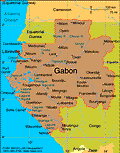
This West African country with the Atlantic as its western border is
also bounded by Equatorial Guinea, Cameroon, and the Congo. Its area is
slightly less than Colorado's. Most of the country is covered by a dense
tropical forest.
Government
Republic.
History
The earliest humans in Gabon were believed to be the Babinga, or
Pygmies, dating back to 7000 B.C., who were
later followed by Bantu groups from southern and eastern Africa. Now there
are many tribal groups in the country, the largest being the Fang peoples,
who constitute 25% of the population.
Gabon was first explored by the Portuguese navigator Diego Cam in the
15th century. In 1472, the Portuguese explorers encountered the mouth of
the Como River and named it “Rio de Gabao,” river of Gabon,
which later became the name of the country. The Dutch began arriving in
1593, and the French in 1630. In 1839, the French founded their first
settlement on the left bank of the Gabon estuary and gradually occupied
the hinterland during the second half of the 19th century. The land became
a French territory in 1888, an autonomous republic within the French Union
after World War II, and an independent republic on Aug. 17, 1960.
Albert-Bernard Bongo became Gabon's second president in 1967. He
changed his name to Omar in 1973, on converting to Islam. Strikes and
riots led to a transitional constitution in May 1990, legalizing political
parties and calling for free elections. In its first multiparty election
in Dec. 1993, Bongo received just over 51% of the vote, while the
opposition candidate alleged fraud and tried to establish a rival
government.
In Dec. 1998, President Bongo, who had by then ruled the country for 31
years, was elected for an additional seven. Gabon lacks roads, schools,
and adequate health care, yet the oil-rich country has lined the pockets
of its ruler, who, according to the French weekly L'Autre Afrique,
is said to own more real estate in Paris than any other foreign leader.
Despite his reputation for corruption and authoritarianism, Bongo has a
strong national following. In July 2003, the country's constitution was
changed, allowing Bongo to be reelected indefinitely; that year, he
changed his name again, to El Hadj Omar Bongo Ondimba. In Dec. 2005, he
was reelected for another seven-year term.
See also Encyclopedia: Gabon. U.S. State Dept. Country Notes:
Gabon
Fact Monster/Information Please®
Database, © 2007 Pearson Education, Inc. All rights reserved.
More on Gabon from Fact Monster:
- Gabon - Gabon Gabon , officially Gabonese Republic, republic (2005 est. pop. 1,389,000), 103,346 sq mi ...
- Gabon - Gabon Profile: People, History, Government and Political Conditions, Economy, Defense, Foreign Relations, U.S.-Gabonese Relations
- Gabon - Map of Gabon & articles on flags, geography, history, statistics, disasters current events, and international relations.
- Gabon: Bibliography - Bibliography See J. Bouquerel, Le Gabon (1970); D. E. Gardinier, Historical Dictionary of Gabon ...
- Gabon: History - History Early History to Independence The region that is now Gabon was inhabited in Paleolithic ...
|
|