Geography
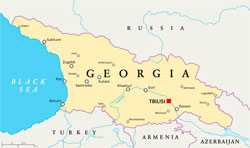
Georgia is bordered by the Black Sea in the west, by Turkey and Armenia in the south, by Azerbaijan in the east, and Russia in the north. The republic also includes the Abkhazia and Ajara autonomous republics and South Ossetia.
Government
Republic.
History
Georgia became a kingdom about 4 B.C. and Christianity was introduced in A.D. 337. During the reign of Queen Tamara (1184–1213), its territory included the whole of Transcaucasia. During the 13th century, Tamerlane and the Mongols decimated its population. From the 16th century on, the country was the scene of a struggle between Persia and Turkey. In the 18th century, it became a vassal to Russia in exchange for protection from the Turks and Persians.
Georgia joined Azerbaijan and Armenia in 1917 to establish the anti-Bolshevik Transcaucasian Federation, and upon its dissolution in 1918, Georgia proclaimed its independence. In 1922, Georgia, Armenia, and Azerbaijan were annexed by the USSR and formed the Transcaucasian Soviet Socialist Republic. In 1936, Georgia became a separate Soviet republic. Under Soviet rule, the country was transformed from an agrarian to a largely industrial, urban society.
Georgia Gains Independence from USSR
Georgia proclaimed its independence from the USSR on April 6, 1991. In Jan. 1992, its leader, Zviad Gamsakhurdia, was sacked and later accused of dictatorial policies, the jailing of opposition leaders, human rights abuses, and clamping down on the media. A ruling military council was established by the opposition until a civilian authority could be restored. In 1992, Eduard Shevardnadze, the Soviet Union's foreign minister under Gorbachev, became president.
During 1992–1993, the government engaged in armed conflict with separatists in the breakaway province of Abkhazia. In 1994, Russia and Georgia signed a cooperation treaty that authorized Russia to keep three military bases in Georgia and allowed Russians to train and equip the Georgian army. In 1996, Georgia and its breakaway region of South Ossetia agreed to a cessation of hostilities in their six-year conflict. With little progress in resolving the Abkhazia situation, however, Parliament in April 1997 voted overwhelmingly to threaten Russia with loss of its military bases, should it fail to extend Russian military control over the separatist region. In 1998, the U.S. and Britain began an operation to remove nuclear material from Georgia, dangerous remains from its Soviet years. A darling of the West since his days as the Soviet Union's foreign minister, Shevardnadze was viewed far less favorably by his own people, who were frustrated by unemployment, poverty, cronyism, and rampant corruption. In the 2000 presidential elections, Shevardnadze was reelected with 80% of the vote, though international observers determined the election was marred by irregularities.
U.S. Supports Georgia
In 2002, U.S. troops trained Georgia's military in antiterrorism measures in the hopes that Georgian troops would subdue Muslim rebels fighting in the country. Tensions between Georgia and Russia were strained over the Pankisi Gorge, a lawless region of Georgia that Russia said had become a haven for Islamic militants and Chechen rebels.
In May 2003, work began on the Georgian section of the enormously ambitious Baku-Tbilisi-Ceyhan oil pipeline, which runs from Azerbaijan through Georgia to Turkey. The pipeline opened in July 2006.
Massive demonstrations began after the preliminary results of the Nov. 2003 parliamentary elections. The opposition party (and international monitors) claimed that the elections were rigged in favor of Shevardnadze and the political parties who supported him. After more than three weeks of massive protests, Shevardnadze resigned on Nov. 30. Georgians compared the turn of events to Czechoslovakia’s “velvet revolution.” In Jan. 2004 presidential elections, Mikhail Saakashvili, the key opposition leader, won in a landslide. The 36-year-old lawyer built his reputation as a reformer committed to ending corruption, and in his first three years as president, Saakashvili made significant progress in rooting out the country's endemic corruption and establishing a series of reforms. Saakashvili's ongoing difficulty has been reining in Georgia's two breakaway regions, South Ossetia and Abkhazia, both of which are strongly supported by neighboring Russia.
Saakashvili's popularity took a hit in November 2007 when some 50,000 demonstrators gathered outside Parliament in Tbilisi and demanded early elections and his resignation. The opposition accused Saakashvili of abusing power and stifling dissent. After three days of protest, Saakashvili deployed riot police, who used tear gas and rubber bullets to break up the demonstrations, and delcared a state of emergency. Parliament voted 149 to 0 to approve the state of emergency. The opposition in the 235-seat Parliament boycotted the vote, however. Saakashvili later announced that a presidential election would be held in January 2008, and he resigned to run in the race. Saakashvili won the election, taking 52.8% of the vote, enough to avoid a runoff. Voters also voted in a referendum in favor of joining NATO.
Georgia and Russia Are Antagonists in Fight Over Breakaway South Ossetia and Abkhazia
In August 2008, fighting between Georgia and its two breakaway regions, South Ossetia and Abkhazia, broke out. Russia sent hundreds of troops to support the enclaves, launched airstrikes, moved to occupy areas of Georgia. Observers speculated that Russia’s aggressive tactics marked an attempt to gain control of Georgia’s oil and gas export routes.
At the end of August, after a cease-fire agreement between Russia and Georgia was signed, Russian president Dmitri Medvedev severed diplomatic ties with Georgia, officially recognized South Ossetia and Abkhazia as independent regions and pledged military assistance from Russia, heightening tensions between Russia and the West.
Both Russia and Georgia have painted each other as the aggressor responsible for the war—Georgia said it launched an attack in South Ossetia because a Russian invasion was under way, and Russia claimed it sent troops to the breakaway region to protect civilians from Georgia's offensive attack. In November 2008, Erosi Kitsmarishvili, a former Georgian diplomat to Moscow, testified that the Georgian government was responsible for starting the conflict with Russia. Kitsmarishvili stated that Georgian officials told him in April that they planned to start a war in the breakaway regions and were supported by the U.S. government.
The South Ossetian Parliament approved Aslanbek Bulatsev as prime minister on Oct. 22, 2008.
On Oct. 27, 2008, Mikheil Saaksahvili replaced Prime Minister Lado Gurgenidze with Grigol Mgaloblishvili, Georgia's ambassador to Turkey. On Nov. 1, 2008, parliament confirmed Mgaloblishvili as prime minister in a 98 to 11 vote. After only three months in office, Mgaloblishvili resigned from office on health grounds. Nika Gilauri became prime minister in February 2009.
In April 2009, tens of thousands of protesters marched through Tbilisi, demanding Saaksahvili's resignation. However, one year later in May 2010, Saaksahvili's ruling party easily won municipal elections. As part of a series of reforms to placate the opposition, Saaksahvili moved up the elections by six months and allowed voters to elect the mayor of Tbilisi for the first time ever. Giorgi "Gigi" Ugulava, the incumbent mayor and an ally of Saaksahvili, won the election by an overwhelming amount of votes.
Georgia and Russia Reach Trade Agreement
In Nov. 2011, Georgia and Russia agreed to a Swiss-mediated proposal that allowed for the monitoring of trade flow between the two countries. The agreement would allow Russia to join the World Trade Organization (WTO) by December. Membership to the WTO is based on a consensus; therefore, Russia needed to gain the consent of Georgia. Hostilities between the two countries, including a war in 2008, have kept them from an agreement before now. In return for its consent, Georgia asked for direct trading on its border with Russia.
Georgia's President and Prime Minister Engage in Prolonged Power Struggle
Gearing up for parliamentary elections in Oct. 2012, opponents of Saaksahvili's ruling party, United National Movement, held a huge rally in Tbilisi in May. President Saaksahvili's answer to rising opposition was the appointment of ally Vano Merabishvili as new prime minister on June 30.
In a stunning defeat, Saaksahvili's party lost October's parliamentary election to an opposition coalition called Georgian Dream, which is led by reclusive billionaire Bidzina Ivanishvili. Georgian Dream won 54.9% of the vote (85 of 150 seats) and the United National Movement 40.4% (65) with voter turnout at 59.8%. During his nine years as president, Saaksahvili courted the West, moving toward membership in NATO and EU. He was praised for cracking down on crime. However, he was also accused of abusing power and stifling dissent. Saaksahvili was widely expected to breeze to re-election until late September, when a television station broadcast a video showing prison guards torturing inmates. Protests erupted, and the president promised to reform the country's prison system.
Because of constitutional change that will shift the government from a presidential to a parliamentary republic, Saaksahvili will remain in power for a year, and Ivanishvili will become prime minister. At the end of Saaksahvili's term the role of the presidency will be diminished and the prime minister will assume many of the president's powers. In the meantime, the two will have to share power, which could be a complicated situation given their divergent interests: Ivanishvili made much of his fortune in Russian interests, while Saaksahvili, who almost went to war with Russia, has clearly intended to move out from under Russia's shadow.
In May 2013, the uneasy power-sharing situation between President Mikheil Saakashvili and Prime Minister Bidzina Ivanishvili took a hit when former prime minister Vano Merabishvili was ordered to jail to await trial on charges of corruption. Both he and former labor minister Zurab Chiaberashvili, allies of Saakashvili, have been charged with embezzlement and abuse of office for allegedly putting more than 22,000 party activists on the labor ministry's payroll. Saakashvili claimed the charges were politically driven; EU leaders have called on Georgian officials to make sure the judicial process is fair.
Georgia Holds Presidential Elections in October 2013
On October 27, 2013, Georgia held presidential elections. Giorgi Margvelashvili won, taking 62 percent of the vote. Margvelashvili was a member of Bidzina Ivanishvili's cabinet as the Minister of Education and Science. Despite no political party affiliation, Margvelashvili was chosen by the Ivanishvili-led Georgian Dream coalition as their presidential candidate for 2013. After Margvelashvili was elected, Catherine Ashton, the European Union Representative for Foreign Affairs, and Stefan Fule, the Commissioner for Enlargement and European Neighbourhood Policy, released a joint statement congratulating "the Georgian people on this demonstration of their country's strong democratic credentials." The statement also said that they "look forward to continued close cooperation with Georgia on our ambitious mutual agenda of political association and economic integration."
On November 17, 2013, Margvelashvili took office as president. At his presidential inauguration, Margvelashvili said that he hoped Georgia would join the European Union and NATO. Irakli Garibashvili succeeded Ivanishvili as prime minister. Garibashvili, a former business executive, served as Minister of Internal Affairs in Ivanishvili's cabinet.
Unrest in Abkhazia as Parliament Calls for Early Elections
In late May 2014, demonstrators broke into Abkhazia's presidential headquarters and opposition leaders seized control, forming a Provisional National Council in what became known as the May Revolution. Abkhazia's parliament then voted to oust Prime Minister Leonid Lakerbaya and hold early president elections in August. Parliament also asked for President Alexander Ankvab's resignation. Ankvab refused, but fled the capital and resigned three days later. Valery Bganba, the parliament's speaker, acted as Abkhazia's president until Raul Khajimba was elected in August 2014. Khajimba took office the following month.
The territory of Abkhazia remains disputed. Georgia's government and a majority of the international community consider Abkhazia part of Georgia. However, Abkhazia considers itself an independent state, the Republic of Abkhazia, which is recognized by Russia and a handful of other nations.
Further political unrest came in November 2014, when Georgia's Foreign Minister Maia Panjikidze resigned along with four other ministers. Their resignations came after Prime Minister Irakli Garibashvili fired pro-Western Defense Minister Irakli Alasania over a spending dispute. The firing and resignations also led to one of the six ruling coalition parties, the Free Democrats, defecting. Therefore, the Georgian Dream party and its coalition lost its majority in parliament. After resigning, Foreign Minister Maia Panjikidze expressed concern that Georgia was veering away from Europe and moving closer to Russia. However, in a press conference following the resignations, Prime Minister Garibashvili said he remained committed to working on closer ties with Western nations.
See also Encyclopedia: Georgia
U.S. State Dept. Country Notes: Georgia
State Department for Statistics www.statistics.ge/ .