Travel to Namibia — Unbiased reviews and great
deals from TripAdvisor
Namibia
|
Republic of Namibia
President: Hifikepunye Pohamba
(2005)
Prime Minister: Nahas Angula
(2005)
Current government officials
Total area: 318,694 sq mi (825,418 sq km)
Population (2007 est.): 2,055,080
(growth rate: 0.5%); birth rate: 23.5/1000; infant mortality rate:
47.2/1000; life expectancy: 43.1; density per sq mi: 6
Capital and largest city (2003 est.):
Windhoek, 221,000. Summer capital:
Swakopmund, 26,200
Monetary unit: Namibian dollar
Languages:
English 7% (official), Afrikaans is common
language of most of the population and of about 60% of the white
population, German 32%; indigenous languages: Oshivambo, Herero,
Nama
Ethnicity/race:
black 87.5%, white 6%, mixed 6.5%. Note: about
50% of the population belong to the Ovambo tribe and 9% to the
Kavangos tribe; other ethnic groups are Herero 7%, Damara 7%, Nama
5%, Caprivian 4%, Bushmen 3%, Baster 2%, Tswana 0.5%
Religions:
Christian 80%–90% (Lutheran at least 50%),
indigenous beliefs 10%–20%
Literacy rate: 84% (2003 est.)
Economic summary: GDP/PPP (2007
est.): $10.72 billion; per capita $5,200. Real growth rate:
4.4%. Inflation: 6.7%. Unemployment: 5.2%. Arable
land: 1%. Agriculture: millet, sorghum, peanuts, grapes;
livestock; fish. Labor force: 660,000; agriculture 47%,
industry 20%, services 33% (1999 est.). Industries:
meatpacking, fish processing, dairy products; mining (diamonds,
lead, zinc, tin, silver, tungsten, uranium, copper). Natural
resources: diamonds, copper, uranium, gold, lead, tin, lithium,
cadmium, zinc, salt, vanadium, natural gas, hydropower, fish; note:
suspected deposits of oil, coal, and iron ore. Exports: $2.87
billion f.o.b. (2007 est.): diamonds, copper, gold, zinc, lead,
uranium; cattle, processed fish, karakul skins. Imports:
$2.82 billion f.o.b. (2007 est.): foodstuffs; petroleum products and
fuel, machinery and equipment, chemicals. Major trading
partners: South Africa, U.S. (2006).
Communications: Telephones: main lines
in use: 138,900 (2005); mobile cellular: 495,000 (2005). Radio
broadcast stations: AM 2, FM 39, shortwave 4 (2001).
Radios: 232,000 (1997). Television broadcast stations:
2 (2007). Televisions: 60,000 (1997). Internet Service
Providers (ISPs): 3,717 (2007). Internet users: 80,600
(2005).
Transportation: Railways: total: 2,382
km (2002). Highways: total: 42,237 km; paved: 5,406 km;
unpaved: 36,831 km (2002). Ports and harbors: Luderitz,
Walvis Bay. Airports: 137 (2007).
International disputes: commission
established with Botswana to resolve small residual disputes along
the Caprivi Strip, including the Situngu marshlands along the
Linyanti River; Botswana residents protest Namibia's planned
construction of the Okavango hydroelectric dam on Popa Falls;
managed dispute with South Africa over the location of the boundary
in the Orange River; dormant dispute remains where Botswana,
Namibia, Zambia, and Zimbabwe boundaries converge; Angolan rebels
and refugees still reside in Namibia.
Major sources and definitions
|
|
Geography
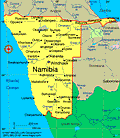
Namibia is bounded on the north by Angola and Zambia, on the east by
Botswana, and on the east and south by South Africa. It is for the most
part a portion of the high plateau of southern Africa, with a general
elevation of from 3,000 to 4,000 ft.
Government
Republic.
History
The San peoples may have inhabited what is now Namibia more than 2,000
years ago. The Bantu-speaking Herero migrated there in the 1600s. The
Ovambo, the largest ethnic group today, migrated in the 1800s.
In the late 15th century, the Portuguese explorer Bartolomeu Dias
became the first European to visit Namibia. Formerly called South-West
Africa, the territory became a German colony in 1884. Between 1904 and
1908, German troops massacred tens of thousands of Herero, who had
revolted against colonial domination. In 1915, during World War I,
Namibian territory was taken over by South African forces. In 1921, it
became a mandated territory of the League of Nations, under the
administration of South Africa.
Upon the dissolution of the League of Nations in 1946, South Africa
refused to accept United Nations authority and to replace its mandate with
a UN trusteeship. A black Marxist separatist group, the South West African
People's Organization (SWAPO), formed in 1960 and began small-scale
guerrilla attacks aimed at achieving independence. In 1966, the UN called
for South Africa's withdrawal from the territory, and officially renamed
it Namibia in 1968. South Africa refused to obey. Under a 1974 Security
Council resolution, South Africa was required to begin the transfer of
power or face UN action. Prime Minister Balthazar J. Vorster rejected UN
supervision, claiming that his government was prepared to negotiate
Namibian independence, but not with SWAPO, which the UN had recognized as
the “sole legitimate representative” of the Namibian people.
South Africa handed over limited powers to a new multiracial
administration in 1985 (the previous government had enforced South
Africa's apartheid laws). Installation of this government ended South
Africa's direct rule, but South Africa retained an effective veto over the
new government's decisions. Finally, in 1988 South Africa agreed to a plan
for independence. SWAPO leader Sam Nujoma was elected president, and on
March 21, 1990, Namibia achieved independence.
Nujoma was reelected in 1994 and again in 1999, after the constitution
was amended to allow him to seek a third term. Nujoma announced in Nov.
2001 that he would not seek reelection when his term expired in 2004. In
Nov. 2004, Hifikepunye Pohamba of SWAPO was elected president with 76% of
the vote. He took office on March 21, 2005.
In 2004, Germany issued a formal apology for the massacre of Herero by
German colonial troops between 1904 and 1908.
See also Encyclopedia: Namibia U.S. State Dept. Country Notes:
Namibia Central Bureau of Statistics http://www.npc.gov.na/cbs/index.htm .
Information Please® Database, © 2007 Pearson Education,
Inc. All rights reserved.
More on Namibia from Fact Monster:
- Namibia - Namibia Namibia , officially Republic of Namibia, republic (2005 est. pop. 2,031,000), c.318,000 sq ...
- Namibia - Namibia Profile: People, History, Government and Political Conditions, Economy, National Security, Foreign Relations, U.S.-Namibian Relations
- Namibia - Map of Namibia & articles on flags, geography, history, statistics, disasters current events, and international relations.
- Namibia: Bibliography - Bibliography See H. Bley, South West Africa under German Rule, 1894–1914 (tr. 1971); I. ...
- Namibia: Economy - Economy Because of inadequate rainfall, crops are not widely raised and pastoralism forms the ...
|
|