Wisconsin
State abbreviation/Postal code: Wis./WI Governor: Scott Walker, R (to Jan. 2019) Lieut. Governor: Rebecca Kleefisch, R (to Jan. 2019) Senators: Ron Johnson, R (to Jan. 2019); Tammy Baldwin, D (to Jan. 2019) Historical biographies of Congressional members Secy. of State: Douglas J. La Follette, D (to Jan. 2019) State Treasurer: Matt Adamczyk, R (to Jan. 2019) Atty. General: Brad Schimel, R (to Jan. 2019) Organized as territory: July 4, 1836 Entered Union (rank): May 29, 1848 (30) Present constitution adopted: 1848 Motto: Forward
Nickname: Badger State Origin of name: French corruption of an Indian word whose meaning is disputed 10 largest cities (2010 est.): Milwaukee, 594,833; Madison, 233,209; Green Bay, 104,057; Kenosha, 99,218; Racine, 78,860; Appleton, 72,623; Waukesha, 70,718; Oshkosh, 66,083; Eau Claire, 65,883; Janesville, 63,575 Land area: 65,498.37 sq mi (169,640 km2) Geographic center: In Wood Co., 9 mi. SE of Marshfield Number of counties: 72 Largest county by population and area: Milwaukee, 947,735 (2010); Marathon, 1,545 sq mi. State parks, forests, and recreation areas: 95 Residents: Wisconsinite 2016 resident population est.: 5,778,708 2010 resident census population (rank): 5,686,986 (20). Male: 2,822,400 (49.6%); Female: 2,864,586 (50.4%). White: 4,902,067 (86.2%); Black: 359,148 (6.3%); American Indian: 54,526 (1.0%); Asian: 129,234 (2.3%); Other race: 135,867 (2.4%); Two or more races: 104,317 (1.8%); Hispanic/Latino: 336,056 (5.9%). 2010 percent population 18 and over: 76.4; 65 and over: 13.7; median age: 38.5. |
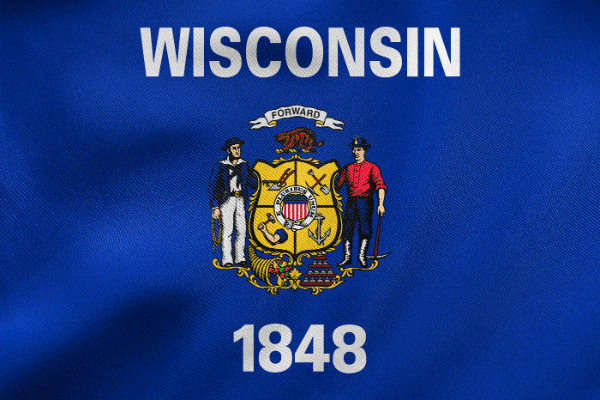

The Wisconsin region was first explored for France by Jean Nicolet, who landed at Green Bay in 1634. In 1660 a French trading post and Roman Catholic mission were established near present-day Ashland.
Great Britain obtained the region in settlement of the French and Indian Wars in 1763; the U.S. acquired it in 1783 after the Revolutionary War. However, Great Britain retained actual control until after the War of 1812. The region was successively governed as part of the territories of Indiana, Illinois, and Michigan between 1800 and 1836, when it became a separate territory.
Wisconsin is a leading state in milk and cheese production. Other important farm products are peas, beans, beets, corn, potatoes, oats, hay, and cranberries.
The chief industrial products of the state are automobiles, machinery, furniture, paper, beer, and processed foods. Wisconsin ranks first among the paper-producing states. The state's mines produce copper, iron ore, lead, and zinc.
Wisconsin is a pioneer in social legislation, providing pensions for the blind (1907), aid to dependent children (1913), and old-age assistance (1925). In labor legislation, the state was the first to enact an unemployment compensation law (1932) and the first in which a workman's compensation law actually took effect. In 1984, Wisconsin became the first state to adopt the Uniform Marital Property Act.
The state has over 14,000 lakes, of which Winnebago is the largest. Water sports, ice-boating, and fishing are popular, as are skiing and hunting. The 95 state parks, forests, and recreation areas take up one-seventh of the land.
Among the many points of interest are the Apostle Islands National Lakeshore; Ice Age National Scientific Reserve; the Circus World Museum at Baraboo; the Wolf, St. Croix, and Lower St. Croix national scenic riverways; and the Wisconsin Dells.
For several weeks in early 2011, tens of thousands of state employees and teachers staged protests in Madison, Wisconsin, camping out near the Capitol's rotunda. They were protesting Governor Scott Walker's plan to cut collective bargaining rights and workers' benefits in an effort to solve the state's budget problems. The protests received international attention, especially from countries like Egypt, which were involved in their own political uprisings at the same time.
In June 2012, Scott Walker became the first governor in U.S. history to survive a recall election. Once again he beat Tom Barrett, mayor of Milwaukee and Walker's 2010 opponent.
See more on Wisconsin:
Encyclopedia: Wisconsin
Encyclopedia: Geography
Encyclopedia: Economy
Encyclopedia: Government
Encyclopedia: History
Monthly Temperature Extremes
All U.S. States: Geography & Climate
Printable Outline Maps
Record Highest Temperatures
Record Lowest Temperatures
Highest, Lowest, and Mean Elevations
Land and Water Area
All U.S. States: Population & Economy
Historical Population Statistics, 1790–Present
Per Capita Personal Income
Minimum Wage Rates
State Taxes
Federal Government Expenditure
Percent of People in Poverty
Births and Birth Rates
Homeownership
Percentage of Uninsured by State
All U.S. States: Society & Culture:
Most Livable States
Healthiest States
Most Dangerous States
Smartest States
Crime Index
Residency Requirements for Voting
Compulsory School Attendance Laws
Driving Laws
National Public Radio Stations
Selected famous natives and residents:
- Don Ameche actor;
- Roy Chapman Andrews naturalist and explorer;
- Walter Annenberg media tycoon and philanthropist;
- Lynda Barry cartoonist, author;
- Carrie Catt woman suffragist;
- John R. Commons economist;
- Tyne Daly actress;
- August Derleth author;
- Jeanne Dixon seer;
- Zona Gale novelist;
- Eric Heiden skater;
- Woody Herman band leader;
- Hildegarde singer;
- Harry Houdini magician;
- Colin Kaepernick NFL quarterback;
- Hans V. Kaltenborne journalist;
- Pee Wee King singer;
- George F. Kennan diplomat;
- Robert La Follette politician;
- William D. Leahy admiral;
- Liberace pianist;
- Charles Litel actor;
- Allen Ludden TV host;
- Alfred Lunt actor;
- Frederic March actor;
- Jackie Mason comedian;
- John Ringling North circus director;
- Pat O'Brien actor;
- Georgia O'Keeffe painter;
- Charlotte Rae actress;
- William H. Rehnquist jurist;
- Gena Rowlands actress;
- Paul Ryan politican;
- Tom Snyder newscaster;
- Peter Straub author;
- Spencer Tracy actor;
- Thorstein Veblen economist;
- Orson Welles actor and producer;
- Laura Ingalls Wilder author;
- Thornton Wilder author;
- Charles Winninger actor;
- Frank Lloyd Wright architect.