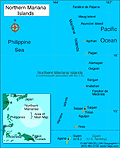
Northern Mariana IslandsCOMMONWEALTH OF THE NORTHERN MARIANA ISLANDS Status: Commonwealth Governor: Benigno R. Fitial (2006) Capital: Chalan Kanoa (on Saipan) Total area: 184 sq mi (477 sq km) Population (2006 est.): 82,459 (growth rate: 2.5%); birth rate: 19.4/1000; infant mortality: 7.0/1000; life expectancy: 76.1; density per sq mi: 448 Languages: English (official), Chamorro, Carolinian Ethnicity/race: Chamorro, Carolinian, other Micronesian, Caucasian, Japanese, Chinese, Korean Religion: Primarily Roman Catholic Literacy rate: 97% (1980 est.) Monetary unit: U.S. dollar Economic summary: GDP/PPP (2000 est.): $900 million; note: GDP numbers reflect U.S. spending; per capita $12,500. Real growth rate: n.a. Inflation: 1.2% (1997 est.). Unemployment: n.a. Arable land: 13%. Agriculture: coconuts, fruits, vegetables; cattle. Labor force: 6,006 total indigenous labor force; 2,699 unemployed; 28,717 foreign workers (June 1995). Industries: tourism, construction, garments, handicrafts. Natural resources: arable land, fish. Exports: $ n.a.: garments. Imports: $ n.a.: food, construction equipment and materials, petroleum products. Major trading partners: U.S., Japan (2004). Communications: Telephones: main lines in use: 21,000 (1996); mobile cellular: 1,200 (1995). Radio broadcast stations: AM 2, FM 3, shortwave 1 (1998). Radios: n.a.. Television broadcast stations: 1 (on Saipan and one station planned for Rota; in addition, two cable services on Saipan provide varied programming from satellite networks) (1997). Televisions: n.a.. Internet Service Providers (ISPs): 1 (2001). Internet users: n.a. Transportation: Railways: 0 km. Highways: total: 362 km (1991); paved: n.a. km; unpaved: n.a. km. Waterways: none. Ports and harbors: Saipan, Tinian. Airports: 6 (2002). International disputes: none. Major sources and definitions |
The Northern Mariana Islands, east of the Philippines and south of Japan, include the islands of Rota, Saipan, Tinian, Pagan, Guguan, Agrihan, and Aguijan. Although sighted by Ferdinand Magellan in 1521 as he sailed for Spain, the islands were not settled by Europeans until 1668, when missionaries converted the indigenous Chamorro people to Catholicism. They were ruled successively by Spain, Germany, and Japan before they became a UN Trusteeship (administered by the U.S.) after World War II. The Commonwealth of the Northern Mariana Islands (CNMI) became part of the United States in Nov. 1986. Spanish cultural traditions remain strong. In recent years, Saipan's garment industry has been accused of exploiting thousands of Asian immigrants. Saipan's territorial status enables its employers to claim their clothing is “Made in the USA,” while paying workers low wages and sidestepping import duties and tariffs. See also Encyclopedia: Northern Mariana Islands.
Fact Monster/Information Please® Database, © 2007 Pearson Education, Inc. All rights reserved. More on Northern Mariana Islands from Fact Monster:
- Northern Mariana Islands - Map of Northern Mariana Islands & articles on flags, geography, history, statistics, disasters, and current events.
- Northern Mariana Islands - Northern Mariana Islands Northern Mariana Islands , commonwealth associated with the United States ...
- Ladrones Islands - Ladrones Islands: Ladrones Islands: see Northern Mariana Islands.
- Micronesia - Micronesia Micronesia , one of the three main divisions of Oceania, in W Pacific Ocean, north of ...
- Anatahan - Anatahan Anatahan, uninhabited volcanic island, 12.5 sq mi (32 sq km), Saipan dist., Northern ...
|
|