Origin of the Universe

The universe is believed to have originated about 15 billion years ago as a dense, hot globule of gas expanding rapidly outward. At that time, the universe contained nothing but hydrogen and a small amount of helium. There were no stars and no planets. The first stars probably began to form out of hydrogen when the universe was about 100 million years old. This is how our Sun originated about 4.49 billion years ago.
Many stars came into being before the Sun was formed; many others formed after the Sun appeared. This process continues, and through telescopes we can now see stars forming out of compressed pockets of hydrogen in outer space.
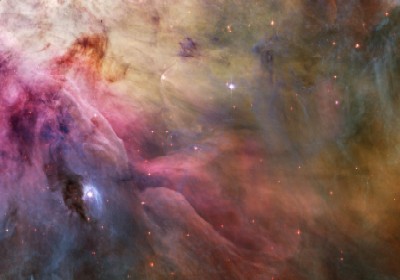
The Orion Nebula is a picture book of star formation, from the massive, young stars that are shaping the nebula to the pillars of dense gas that may be the homes of budding stars. More than 3,000 stars of various sizes appear in this image.
In 1992, instruments aboard the Cosmic Background Explorer (COBE) satellite showed that 99.97 percent of the energy of the universe was released within the first year of its origin. This evidence seems to confirm the Big Bang theory, which holds that the universe originated from a single violent explosion (a big bang) of a very small amount of matter of extremely high density and temperature.
Astronomers also theorize that 99% of the matter in the universe is invisible, or dark matter, composed of some kind of matter that is difficult to detect.

In 2007, an international team of astronomers using NASA's Hubble Space Telescope created a three-dimensional map that provides the first direct look at the large-scale distribution of dark matter in the universe.
Photos courtesy of NASA