The Large Hadron Collider

The world's most sophisticated and expensive science project
by Mark Hughes and Beth Rowen
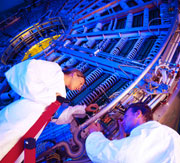 Two scientists checking equipment in the central tube of the LHC. Photo by Antonio Saba courtesy of CERN Related Links |
On March 30, 2010, 15 months after the world's most expensive and sophisticated science experiment was shut down for repairs, the Large Hadron Collider (LHC), a 17-mile-long looped track located an average of 300 feet beneath the Swiss-French border, accelerated two beams of particles to 7 tera electron volts (TeV) and then smashed them together. The collision earned the LHC the distinction of being the world's highest energy particle accelerator, breaking by three-and-a-half times the previous record held by the Fermi National Accelerator Laboratory's Tevatron machine, which is located in Batavia, Illinois.
Built over the span of 14 years by Geneva's CERN Laboratories at a cost of more than $8 billion, the LHC was activated for the first time in September 2008. The length of the track aids in pushing trillions of protons to speeds reaching 99.99% the speed of light. This means protons can travel 11,000 times around the track in a single second, producing more than a billion head-on collisions.
Super-Smash up
Physicists are using the LHC to conduct experiments designed to enhance our understanding of the origin and evolution of the universe. One of the most anticipated experiments will involve re-creating the particles that were present about a trillionth of a second after the Big Bang. This primordial energy will be generated by accelerating protons to 7 TeV and having two beams of particles crash into each other. In November 2009, when the LHC was operational again, the particles were accelerated to 450 billion electron volts—merely a fraction of the 7 trillion electron volts that physicists hope to achieve.
Mystery Solved?
Physicists hope the LHC will help solve such mysteries as the origin of mass. At present, the mass of any object can be found easily, but answering the question of where mass itself comes from is elusive. The Higgs particle, also called the Higgs Boson or "God particle," has been theorized as the source of mass in the universe. Mathematical evidence for these particles has been an accepted and unifying feature of physics for the last quarter century, but direct evidence for the existence of these particles has yet to be found—until July 4, 2012, when CERN announced the discovery of a particle "consistent" with the Higgs boson, the missing piece of physics' Standard Model that was first hypothesized in the 1960s. Whether or not this new particle is the final piece that completes the Standard Model, or is the first piece in a yet-to-be discovered puzzle, its discovery is exciting and its study will shed light on some of the universe's deepest mysteries including dark matter, the early life of planets, and the future of the universe.
Will the LHC Destroy the World?
Prior to the activation of the LHC, some people voiced concern that it would destroy the world. Click here to read about the five most common fears about the LHC and reasons why you should not be worried.
- More from Science