Lost Islands of the World

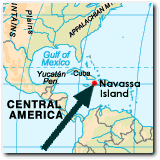 |
Columbus managed to find Navassa in 1507, yet today the island remains virtually invisible to the tourists and cruise ships that swarm the Caribbean. Located between Haiti and Jamaica, Navassa is in fact an American territory, but so obscure that even former secretary of the interior Bruce Babbit—the man once in charge of the territory—confessed: "I had never heard of Navassa. I didn't have the faintest idea whether it was in the Arctic, the Atlantic, or the Pacific." A true lost island —yet so close to home.
Two square miles of limestone and coral provide a haven for 200 species of plants and animals found nowhere else in the Caribbean. The waters surrounding Navassa are almost completely unpolluted, and its coral reef is considered one of the most pristine in the world.
Visiting scientists have reported a few downsides: "It's not just that there's no fresh water. The climate is quite unbearable." The topography is rough and pitted, "something like Swiss cheese with an enormous number of holes . . . an early explorer said that it takes four hours to walk a mile." And the island is literally crawling with scorpions—three different species, in fact. Should this not count as a benefit in your book, just remember: where there are scorpions there are no cruise ships.
Take a small boat fifty miles west of Haiti and you're there. A minor drawback is that Haiti as well as the U.S. claims the island, so keep a low profile once you hit Port-au-Prince. And before leaving American shores, obtain the necessary permit from the U.S. Department of the Interior, which lists 21 rules and regulations on how to behave on Navassa (for instance, there is to be absolutely no importation of tomatoes).
It's best if you approach the island on a calm day, since it's surrounded by formidable cliffs that jut out at an angle, making it easy to be swept under the cliffs and crushed. According to scientists who've been there, you'll need a ladder to scale the cliffs and reach land. When planning your trip, avoid Haitian fishing season—a few fisherman actually camp on the island then. And at all costs avoid overlapping with the occasional scientific expedition; the last thing you want is to share your acre in paradise with a bunch of biologists sniffing around the flora and fauna.
In addition to its natural treasures, Navassa exemplifies a bizarre chapter in the history of American imperialism: the Guano Act of 1856. Guano, the Peruvian word for bird manure, was as good as gold in the second half of the 19th century, as it made superb fertilizer. To encourage business, Congress passed the Guano Act:
"When any citizen or citizens of the United States may have discovered . . . a deposit of guano on any island, rock, or key not within the lawful jurisdiction of any other government, and not occupied by the citizens of any government… said island, rock, or key may . . . be considered appertaining to the United States."
This meant that Congress essentially "deputized each American citizen to claim territory for the commonwealth, an act with no parallel in history," according to The Great Guano Rush: Entrepreneurs and American Overseas Expansion, a history of the period by Jimmy M. Skaggs. "For a decade following . . . American entrepreneurs seemed to lay claim to every island, rock, or key around the globe that might possess fertilizer." Through the act the U.S. gained a total of 79 tiny territories around the world, and still controls eight of them, including Navassa.
The island was claimed in 1857, a year after passage of the Act. The Navassa Phosphate Company mined the island until 1900, enlisting hundreds of freed American slaves to dig out several tons of guano. Working conditions were so brutal that the laborers finally revolted in 1889, killing their supervisors.
Navassa may be coming to the end of its blissful obscurity, so plan your trip accordingly. Not only is the island claimed by both the U.S. and Haiti, but by a Californian named William Warren. He is suing the U.S. government, claiming that he "rediscovered" the island, which makes it rightfully his under the Guano Act. In addition to mining guano, Warren plans to use Navassa as a base for his company, which hunts for shipwrecked galleons. He has also commented, apparently without irony: "I'd like to develop a casino there." Surely those who love the solitude of deserted islands are not alone in wishing that a plague of guano and scorpions befall him.
 Clipperton Island |  Introduction |  Heard Island and McDonald Islands |